A Message to the First Responders in Gay Kids’ Lives

Why We Need to Ditch the Politics of Blame and Move Toward Sharing Responsibility for the Loss of Tyler Clementi

By Mary Gray

Tyler Clementi’s death on 22 September 2010 was one of several highly publicized youth suicides that fall. In several cases, media coverage and political discourse connected these tragedies to cases of on and offline harassment saturated in homophobic sentiment. Research among students (visit custom research paper writing service) suggests that these hostilely charged environments are the norm rather than the exception. For lesbian, gay, bisexual, transgender, and questioning (LGBTQ) youth contemplating suicide, parents, peers, educators, faith leaders, and LGBTQ community advocates are key “first responders”—caring individuals on the scene, providing support—in the wake of this ubiquitous animus. Rallying to punish Dharun Ravi, the former Rutgers student standing trial for 15 criminal counts, including tampering with witnesses and evidence, invasion of privacy, and bias intimidation of Tyler Clementi, does not do justice to Clementi’s life nor does it move us one step closer to preventing another young person, like him, from turning to suicide.

Yet, for the past 2 years, anti-bullying advocates have had their collective frustration and political clout harnessed to further criminalize bullying rather than bolster the roles and resources of invaluable LGBTQ youth “first responders” on the ground. States and school districts rushed to crack down on bullies, prompted, in some cases, by their own convictions but, surely in others, by a political desire to appease constituencies without having to take an explicit stand on anything (who could be for bullying, after all). As a result, a record number of anti-bullying policies are now on the books. However, we have no concrete evidence that such top-down policies prevent or counteract bullying, particularly harassment carried out through texting and online social networks. Worse yet, some research on violent harassment among youth suggests that framing the problem as “bullying” actually works against youth reporting violence or identifying themselves as targets of it (Marwick and boyd 2011).

As we move forward, we need to shift from a dead-end politics of blame to build out the sources of support and ethos of shared responsibility that could make a difference, literally, between life and death for LGBTQ young people.

Rethinking homophobia. Tracing a causal link between Ravi’s homophobic actions and Tyler Clementi’s suicide dangerously oversimplifies homophobia. This formula suggests that homophobia is something “individuals have” rather than what our cultural norms perpetuate. Rather than presume homophobia vents an individual’s fear of homosexuality, researchers, such as sociologist CJ Pascoe (2007), have persuasively argued that it is a portable (I would argue concealable) weapon for policing sexuality and shoring up the fragile gender identities emblematic of tween and teen life. Young people, like Clementi, searching for communities to reflect who they are must constantly weigh if talking about how they feel, whether it’s with parents, close friends, or complete strangers, will work for or against them. If we are serious about preventing bullying and suicide, we need a calculus that always works in a young person’s favor.

The homophobia expressed in Ravi’s disgust for Clementi’s intimacy with another man, as much as the racism conveyed in Clementi’s joking suggestions that Ravi’s South Asian parents owned a Dunkin’ Donuts, signal our limited capacity to celebrate difference. We need to stop telling young people what they shouldn’t say or do and start teaching them—and ourselves—the social and emotional literacies they need to challenge the way they see themselves and each other. It’s time to start having direct conversations with students (beyond the platitude that such name calling “isn’t nice)” about the power that words like “fag,” “no homo,” “bitch,” and others circulate, not only through the person targeted by the slur, but also the person hurling it. Only then can we hope to turn homophobia from an easy insult to a powerful analytic tool for mining our own fears, insecurities, and discomforts with difference.

Expanding parental support/holding parents accountable. One of the few things we know for sure is that parents, guardians, and adult mentors make a difference in the lives of LGBTQ youth. A young person, for example, who lives in fear of a parent’s condemnation is more likely to hurt themselves than a young person who feels supported and accepted at home (Ryan 2009). This is not surprising. But by not explicitly recognizing parents’ roles, we undermine their importance as a strategy for combating LGBTQ youth bullying and suicide. Parents and guardians provide a measure of incomparable respite when they celebrate, rather than stand neutral or second-guess a young person’s decision to question what it means to be straight. A modest expression of acceptance makes a measureable difference. But even that can be a tall order. Adults must negotiate and account for their own doubts and anxieties when a child asks such questions before they can effectively offer first responder support. Parents shouldn’t have to go it alone and, realistically, can’t do it all. They need allies, from family, faith communities, and other positive social networks, to counter the violence and hostility rampant in school environments and circulating online. We will know we’ve reached our goal when every young adult imagines they’d celebrate, rather than endure or suffer through, having an LGBTQ-identifying child of their own.

Focusing on basic research. Educators, researchers, and policy makers need to acknowledge that we know next to nothing about the quality of young LGBTQ people’s lives before we can even begin to contribute to meaningful strategies for supporting them. The data we arm ourselves with, even the universally cited statistics on higher suicide rates among lesbian and gay youth perpetuate a rudimentary, generic picture (Waidzunas 2011). But we have no idea what daily life is like for the average LGBTQ-identifying teen. Right now, there is no national instrument for measuring young people’s positive experiences around sexuality and gender. Most states don’t ask a single question about LGBTQ youth on their annual Youth Risk Behavior Survey, effectively erasing them from the discussion at the state and district level. Indeed, Massachusetts remains the only state with a standing Commission on GLBT Youth that funds support programs in its public schools through its department of education that gather data on the effectiveness of LGBTQ-specific outreach and education. What we need is a national, coordinated effort that links programming, outreach, and research on behalf of LGBTQ youth.Focusing our collective outrage on prosecuting an individual, whether seeking the harshest punishment we can wring out of Ravi’s case or lobbying for so called “zero-tolerance” policies that automatically expel any student implicated in bullying, implies that homophobia can be rooted out, one bad apple at a time. Turning this into a case of one individual driving Clementi over the edge moves us no closer to seeing the journey that brought Clementi to that edge. When it comes to understanding and preventing youth suicide, our research, educational policies, and legal actions can’t stop at weeding out the presence of homophobic individuals but must demand systems of accountability that address how we individually and collectively perpetuate homophobia in everyday ways. That is why the “first responders” fighting for young people’s federal rights to an equal education and the human right to free expression must call on us to more broadly share responsibility in making those rights universal over narrowly seeking the right bully to blame and lock up.

Citations:

Alice Marwick and danah boyd. (2011). “The Drama! Teen Conflict in Networked Publics.” Paper presented at the Oxford Internet Institute Decade in Internet Time Symposium, September 22. http://ssrn.com/abstract=1926349

CJ Pascoe. (2007). Dude, You’re a Fag: Masculinity and Sexuality in High School. Berkeley: University of California Press.

Caitlin Ryan, David Huebner, Rafael M. Diaz, and Jorge Sanchez. (2009). “Family Rejection as a Predictor of Negative Health Outcomes in White and Latino Lesbian, Gay, and Bisexual Young Adults.” Pediatrics January 2009; 123:1 346-352; doi:10.1542/peds.2007-3524

Tom Waidzunas. (2011). “Young, Gay, and Suicidal: Dynamic Nominalism and the Process of Defining a Social Problem with Statistics.” Science, Technology & Human Values, 0162243911402363-. doi:10.1177/0162243911402363

Mary L. Gray is Senior Researcher at Microsoft Research New England and Associate Professor of Communication and Culture, with affiliations in American Studies, Anthropology, and the Gender Studies Department at Indiana University. She draws on an interdisciplinary background in anthropology and critical media studies to study how people use digital and social media in everyday ways to shape their social identities and create spaces for themselves. Her most recent book, Out in the Country: Youth, Media, and Queer Visibility in Rural America (NYU Press, 2009) examined how youth in rural parts of the United States fashioned “queer” senses of gender and sexual identity and the role that media—particularly internet access—played in their lives and political work. 

Posted in Uncategorized | Tagged | Leave a comment

Gay is Great (Not Just Tolerable)

How many more LGBTQ youth have to commit suicide before we realize that our collective response to this epidemic issue is an utter failure?

I am sick to death of hearing graphic details of the deaths of LGBTQ teenagers in newspaper and across the internet. In my opinion, the worst story to date is in this week’s New Yorker, a feature-length, real time expose* of the interactions among Tyler Clementi’s peers in the days and weeks preceding his death. Chances are good you’ve heard of Tyler Clementi, the Rutgers University freshman who committed suicide last fall after his roommate and across-the-hall neighbor secretly videotaped him in his room and attempted to broadcast the image, along with homophobic epithets, to others via the internet. Apart from contaminating potential jurors by releasing detailed information about the circumstances surrounding Clementi’s death, the article paints a vivid portrait of a young person who deeply valued his privacy and had few positive images of a gay young adulthood he could access.

In a recent OpEd, I argue that focusing exclusively on the deaths of LGBTQ youth is both a damaging and ultimately irresponsible coping mechanism by a media culture that has few words for explaining the complexities of queer lives. Today, I want to extend that argument even further and say that this is a culture-wide problem that may well be directly responsible for some of these deaths. We may need a sober acknowledgement that there is tremendous discrimination against queer youth, but perhaps more importantly, we need to shift from a politics of “tolerance” toward LGBTQ people and youth, to a culture of valuing, celebrating, embracing and encouraging young people to embrace healthy LGBTQ identities and relationships.

In recent years, sociologists have explored the many ways heterosexuality and gender conformity are normalized through the interactions children have with their parents, their peers and in their schools. University of Michigan professor Karin A. Martin explains that most parents assume their children are going to be heterosexual, describe romantic relationships to children as if they are all heterosexual, and make invisible or fail to include LGBTQ adults in their child’s life. For those parents with reason to think their child might be gay, lesbian or gender nonconforming, most adopt a “cross fingers and hope for hetero” approach to parenting or, in some cases, actively discourage homosexuality or gender nonconformity in their children. Though some parents make attempts to prepare their child for life as an LGBTQ adult, she tells us, that is an uncommon reaction.

Parents do these things for a variety of reasons. According to Bates College professor Emily Kane, parents have their own investments in being heterosexual and gender normative. (This is particularly true, she says, for heterosexual fathers.) For many mothers and gay parents, heteronormative parenting represents an attempt to avoid sanction by other people. In any case, the social rewards for producing appropriately gendered, heterosexual children are many, and the images of alternatives to that are few.

What Adrienne Rich described back in 1980 as “compulsory heterosexuality” is producing a generation of youth who cannot imagine a future in which their sense of self is valued, celebrated and socially integrated. They live in a present that devalues their burgeoning sense of self, and forces them to conceal their thoughts and feelings from the people charged with loving, supporting and empowering them. What they learn instead, from the strict omission of positive imagery of queer life, is threefold:

  1. They learn that most adults believe that heterosexuality is the only acceptable identity and practice for children and adults.
  2. They learn that homosexuality is always the inferior choice, even among so-called ally parents.
  3. They learn that queer relationships and identities aren’t among the stories we should use to conceptualize our futures.

It’s not just that heterosexuality is presented as the only, albeit mundane, option. It is actively positioned as exceptional, powerful, magical and transformative, in everything from bedtime stories of G-rated movies.

Isn’t it time for some new stories?

What would happen to the universe if children’s books, like this one, along with movies, television, newspapers and parents, teachers and schools provided little boys with positive, healthy, celebratory, exciting images of femininity to which they could aspire? Probably something along the lines of this: We’d have more happy, well-adjusted feminine little boys with positive self-esteem and socially integrated childhoods.

What would happen to the universe if little girls were told that being a lesbian is a completely valid, wonderful, exciting and creative thing to be? Probably something like this: We would have more young women feeling freer in their choices to be sexual with men, with women, with both or with neither.

Certainly, a public culture that celebrates queerness will probably produce a greater number of queers. But the fact that LGBTQ adults are afraid to say that this may well be an okay, even socially desirable thing to do, is itself a product of compulsory heterosexuality–the cultural erasure and devaluing of queer life. And it needs to stop.

When I was a senior in college, my parents sold my childhood home and asked me to come back to sort through the old books and toys I’d stored in their attic. My nostalgic trip through the contents of several black trash bags revealed that I was a much queerer child than even I remembered. I found a pile of Barbie dolls, all with hair sheared into asymmetrical punk styles or haphazard early versions of the fauxhawk. They were all wearing articles of Ken’s clothing, either cut to fit them or held in place with disintegrating rubber bands or tied pieces of string. One particularly excellent specimen sported arms covered with permanent marker tattoos. In a time when there were few public images of queer women, it appears that I was making my own representations of a fantasy future in which I (and my kick-ass girl crew) could bend the rules of gender and fashion to fit our desires.

Who knew I had such deep internal resources at my disposal? In the absence of any (and I do mean ANY) examples of LGBTQ people in my life, I was searching for images that felt true to my internal sense of self. I knew enough to hide these dolls and the fantasy life they represented from my parents and most of my friends. And I didn’t come out, cut my own hair or embrace my burgeoning butch fashion sense until I was safely ensconced in the nurturing embrace of a small, liberal arts college with a thriving queer student body.

My life would have been so much easier had I not needed to wait. I was lucky, though. I had the internal resources and support from caring adults (who may not have known I was gay, but certainly knew I was unhappy) to hang on until I could more easily define the terms of my own life. I suspect that many of these youth we lose to suicide have fewer of the resources. They need the people around them to celebrate who they are now.

The time has come to change the conversation. It’s time for us to throw away all of our old language around LGBTQ youth: words like tolerance, sensitivity and respect. It’s time to replace them with a language of celebration. It’s time to abandon phrases like “it’s okay to be gay” and replace them with others like “it’s great to be gay,” “your gender is beautiful,” and “difference enriches all of our lives.” They need to know that it’s not just acceptable to live as an LGBTQ adult; it’s wonderful to develop a young gay, lesbian, bisexual, or transgender right now. And it’s also okay not to know just who or what you are.

* I purposely neglect to link to the New Yorker story on Tyler Clementi, because I think it to be an intrusive and irresponsible piece of journalism. Despite the fact that I know it will be widely read, I harbor hope that it won’t contaminate too many suitable jurors or enhance the pain felt by Clementi’s family. I can’t imagine that Clementi himself would be happy to read this intimate account of his life—and his instant message history—either.

Posted in Uncategorized | 2 Comments

My feminist obsession with “Sister Wives”

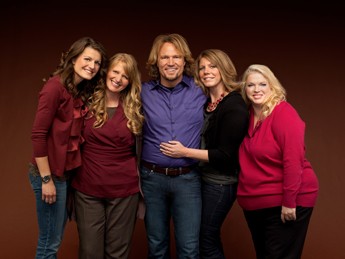
A few months ago, my cousin’s baby mama, who I shall now call my sistercousin, told me that she was hooked on TLC’s reality TV show, Sister Wives. I was down to check out any show that peers into the sex lives of religious conservatives and can be instantly streamed on netflix. Hello! The show follows the adventures of four saucy wives, their shared husband, and their 17 children. Though a lot of fan attention has been paid to Kody—the family’s dorky patriarch—many episodes center more on the wives’ relationships with one another. One wife takes charge, recruits new wives, and keeps the peace (Meri); one loves her career and excuses herself from childcare and domestic work (Janelle); another is the wisecracking stay-at-home mom of everyone’s kids (Christine); and the fourth and newest wife is weepy with gratitude to have three wives and a husband after having been an overwhelmed single mom (Robyn).

Unlike its fictional counterpart Big Love, Sister Wives is a self-conscious show in which members of the Brown family reflect on the impact that “going public”—i.e. not only coming out as polygamists, but also becoming television characters—has had on their relationships, their children, their financial resources and their now tremendous capital as public figures. The show also functions as a platform from which to improve the image of the Fundamentalist Latter Day Saints (FLDS) and oppose the criminalization of plural marriage. The political nature of the show was especially amplified in season two, as Kody, who will henceforth be referred to only as the dorky patriarch, faced arrest for having multiple wives in the state of Utah, a situation that forced the family to move to the promised land of sexual freedom… Las Vegas!

As my sistercousin pointed out, the Brown family borrows heavily from LGBT movement discourse. They tell their dramatic coming out stories (“when I first told so-and-so I was polygamous….”) and they demand that the government should respect their “lifestyle.” At the same time, the Browns go to great lengths to establish the heteronormativity of their plural marriage. When asked about how sex works in their family, they explain that the dorky patriarch rotates among Meri, Janelle, Christine, and Robyn, always going to bed with just one wife at a time, because, as the Browns say, “we don’t do weird.”

Fine. I don’t begrudge them any of this; all subjugated groups borrow from the social justice discourses available to them, and it’s really ok—though less interesting—that they are heterosexual. Far more disappointing, though, is the way they attempt to normalize what is so rare, so desirable, and even so feminist about their lives. Namely, they have figured out a way to actually achieve intimate communal living, collective coparenting and housework, shared financial resources, expanded career opportunities for women who have children, lifelong women’s friendships, nonposssessive partnerships, and deprivatized domestic life. When one woman marries the dorky patriarch, her wives present her with their own wife-to-wife ring, symbolizing their commitment to one another. When one woman loves her career and doesn’t want to spend her days caring for her children, her wife lovingly provides this labor. This same career-loving woman also surrenders her money to the collective, and lovingly buys her wife new bedroom furniture or supports her wife’s ugly quilt-making hobby whether she appreciates the quilts or not. When one woman cannot get pregnant, one of her wives offers to carry her child. When one woman is having marriage trouble, her wife—who knows far more about the limitations of the dorky patriarch than any therapist ever could—counsels her. When one woman’s teenage daughter finds her mother unbearable, her wife takes the daughter in, which means her daughter now lives just down the hall, with a sistermom (or across the street, as is the case of the Browns’ arrangement in Las Vegas). When one woman, an acquaintance, is divorced and lonely, another woman proposes to the dorky patriarch that he consider inviting her to join the family. When one woman has a crisis, whatever it may be, at least one of her wives drops everything to attend to her. And ultimately, when a woman’s husband dies, her living wives remain her married companions until their own deaths.  Talk about the lesbian continuum!

I want this level of closeness and commitment with the women I love, my beloved best friends and sisterwives. These women do not live near me, and we all have jobs, partners, and preferences that we have prioritized. But they are—in addition to Kat (my husbi-wife) and Yarrow (my kiddy-kid)—my home. I have longed for communal, live-in, intimate, feminist life with them for years. I have tried to sister-marry them. I have told them not to leave me. But over the years, I have left them, and they have left me. And though I have no interest whatsoever in a patriarch, or a sexist/heteronormative double standard (where’s my show about the femme matriarch and her four genderqueer husbands??), or a religious ideology, or even nonmonogamy (I’ve tried it… did. not. work.), I envy the Brown family—and any group of folks who figure out how to actually manifest the depth of collective intimacy I long for.

In my very scientific observations of the very serious show Sister Wives, I have come to the conclusion that two things make communal life possible for the Browns and others who accomplish it. The first is obvious: an ideology so important to the people involved that it trumps their individual preferences and personal ambitions. For the Brown family, fundamentalist Mormonism is this ideology. Their commitment to it is so great that they agree to burn through jealousy and the other inevitable difficulties that come with their unconventional lives. As for me, the ideological component is a big hurdle. In the actual practice of my life, queer/feminist collectivism never wins the day. Instead, financial and emotional autonomy/ambition and partner-centeredness have ruled my life. On my death bed, I won’t be surprised if this ends up being a fairly sizable regret. The second element is infrastructure. Because the Brown family is embedded in a religious community that values plural marriage, they know the people who can help them make communal life actually happen—like architects who specialize in building homes for polygamous families, for instance. The Brown family home was built by an architect in the FLDS church, and as a result, it was built so that each wife has her own wing, allowing for some private space while also being connected to the commune. Super dreamy. Though in my fantasy, my sisterwives and I all have cottages, with a central house for meals and family yoga, movies, and what have you.

So here’s the question?

Why have queers and feminists ceded collective domesticity to the religious? Where are the queer architects who are building the communes that intervene in homonormativity and that facilitate collective caretaking? As I have argued elsewhere (http://feministpigs.blogspot.com/2011/09/its-not-that-it-gets-better-its-that.html), straight people have a lot to learn from queers about how to live, but perhaps queers also have a few things we could learn from some of the very same folks who funded the anti gay-marriage campaigns—those fundamentalist Mormons who know how to make communal life work.

In sum, I’d like to say—to Rachel, Melissa, Margaux, and Layla—should you ever read this: Will you marry me?

Posted in Uncategorized | 5 Comments

Welcome to Social (in)Queery!

Have you ever wished there was a more publicly accessible queer social science? Well, now there is! Social (in)Queery is a collaborative project that seeks to expand the range of solid, empirically informed intellectual discourse on issues relevant to contemporary LGBTQI life. In the coming months, we plan to offer a range of commentary from some of the leading university-based researchers in the social sciences. So, sit back and relax (or get riled up, if that’s your thing). And to all our colleagues out there with burning social issues or questions you’d like to explore, be sure to drop us a line and tell us you’d like to contribute! We’d love to have you join in the conversation!

Tey Meadow, CJ Pascoe and Jane Ward

Posted in Uncategorized | Leave a comment